
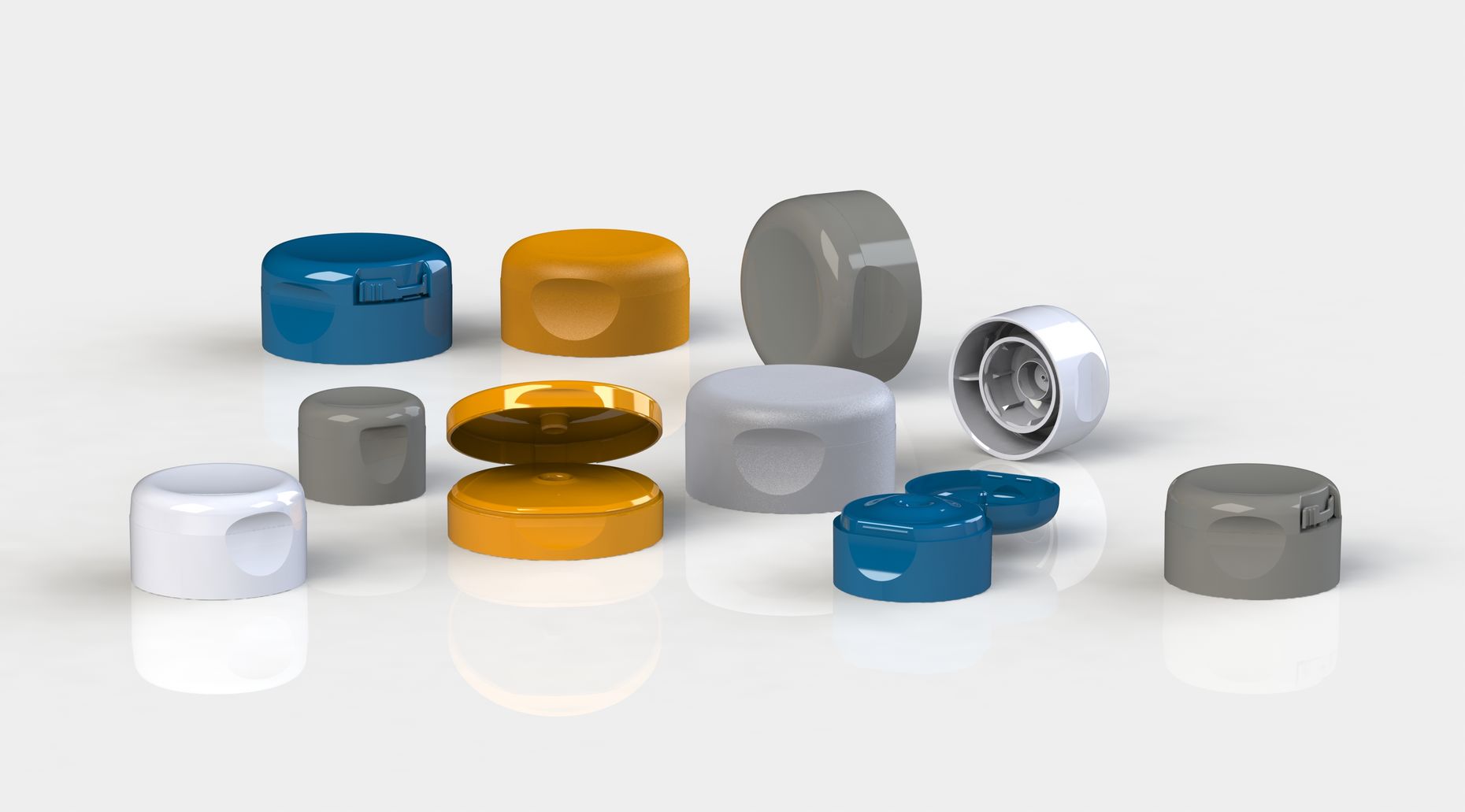
KM Packaging GmbH is a leading supplier of innovative closure systems. Created when Kutterer Kunststofftechnik and Mauer AG merged to form Kutterer Mauer AG, it became KM Packaging GmbH in 2021. The company produces over 6.5 billion injection-moulded parts every year, including tube and bottle closures, cannulas, jar lids and customised packaging solutions. It supplies these worldwide to well-known customers in the tube industry as well as major manufacturers of branded cosmetic and pharmaceutical products. The company has 495 employees working at six sites in Germany, Austria, Poland and the USA.
Obtaining everything from a single source means fewer interfaces
KM Packaging GmbH has been an item customer for over a decade, using components from the item Building Kit System in all areas of production. The packaging specialist has also been utilising a variety of solutions from the item Conveyor Belt System for a while, having obtained initial details about these still relatively new item products at a mobile sales event on site. It is now making widespread use of the conveyor belts in its production operations to transport both individual components and finished products as well as empty and filled boxes. “In the future, we want to use systems predominantly from a single manufacturer in order to minimise the associated interfaces,” says Tobias Kamuf, Project Manager Plant Planning/Automation at KM Packaging GmbH. “We also opted for item due to the international availability of its components. After all, we also use the conveyor belt systems at our production plant in Hebron in the USA,” he adds. item has a very comprehensive portfolio of compatible components, making it possible to design almost anything.
Transporting products and components reliably
KM Packaging places high demands on the conveyor belt systems it uses in production operations. They are expected to be durable, reliable and robust. What’s more, the production environment must meet the requirements of the Food and Drug Administration (FDA) to ensure no particles from the equipment and tools being used are transferred to the products and contaminate them. When building its production systems, the packaging specialist depends on rapid assembly with no complications. KM Packaging uses numerous item components to automate its assembly and packaging processes, including multiple Double Timing Belt Conveyors and Flat Belt Conveyors in various lengths and widths. It utilises Flat Belt Conveyors, for instance, to transport individual components to assembly and finishing machines and take finished closures to a filling station. The company’s rotary table assembly system provides a specific example of the automated process. This system produces a special closure consisting of three parts – a cannula, a threaded ring and a cap. Various conveying systems take these plastic parts to an assembly system. The cannulas are transported using the item Flat Belt Conveyor, on conveyor belts 80 mm wide. These cannulas are inserted at the first station of the rotary table assembly system. The table then turns anticlockwise. At the next stations, the threaded ring is applied and pressed into place. The component is then checked. If the result of this check is satisfactory, a robot screws on the outer cap. At the end of this assembly process, the finished closure is also checked. If the parts have been fitted correctly, the component is transported to the filling station on another item Flat Belt Conveyor.
Rotary table assembly system – made almost entirely from item components
Empty boxes measuring 600 mm x 400 mm make their way to the filling station on Double Flat Belt Conveyors with belts 80 mm wide. When the sensor technology identifies the empty box is in the correct position, the filling process starts automatically. The loose, finished closures fall from the Flat Belt Conveyor via a buffer element into the box until it contains the required quantity. Sensors check this, too. Next, the filled boxes continue their journey on conveyor belts or roller conveyors from item and are prepared for shipping. item components are not just used for the entire filling system, but also for the rotary table assembly system’s machine cabin and for supplying the parts. The highly functional machine cabin that houses the rotary table assembly system is made from item Line XMS profiles. Integrated cable conduits and special seals to protect against dirt and dust are just two of the advantages of these high-performance machine modules. Their closed outer surfaces also make them very easy to clean. As a result, the sensitive assembly process is ideally protected against external influences. KM Packaging also uses an item Stairway/Platform System with three steps as a climbing aid in its assembly process. This is needed, for instance, when machine operators have to top up the container holding the individual parts, which is attached to the side of the relevant machine at a height of two metres. After being filled manually, the machine produces finished closures for 45 minutes before the container has to be topped up again. “The constructions – from the enclosure and the base structure for the rotary table assembly system to the machine peripherals, filling station and stairway system – can be ideally adapted to the relevant requirements,” explains Kamuf. “As a result, carrying out the automated assembly and packaging processes is much easier than with a welded structure or other systems that are rigid and offer far less flexibility,” he adds.
Comprehensive portfolio and perfect digital support
This excellent flexibility is one of the numerous advantages of item constructions. For example, KM Packaging is benefiting from the wide range of profiles and other components. “We can get everything we need to carry out automated projects with this degree of complexity from item – from individual profiles and the feet of the base frames to panel elements made from special materials such as polycarbonate, which is exceptionally tough and shatterproof and virtually indestructible,” emphasises Tobias Vowinkel from KM Packaging’s technical management/die-making team. The item Conveyor Belt System with its wide-ranging designs is the perfect complement to this portfolio. All the basic models are easy to adapt to the relevant requirements. Assistance is provided by the item Engineeringtool, which enables custom configuration. Users do not need to pay for this tool, which offers free, rules-based 3D engineering directly in their browser. This means the Conveyor Belt System can also be flexibly combined with other systems. For example, it can be easily linked to a Work Bench System made from item profiles. A whole host of design options are open to users, who also automatically receive full project documentation. The CAD data available for each system can be downloaded and integrated into the relevant company’s design engineering program. Coordination with everyone involved in the project and the ordering process also take place directly in the item Engineeringtool. This greatly simplifies design engineering processes and speeds up project implementation.
Impressive system and service
“We were impressed not only with the item Building Kit System, but also with the support, service and short delivery times,” emphasises Vowinkel. “We’ve therefore already built another assembly system based on item profiles and are currently planning to finish off a labelling machine that will also have a base frame and conveying technology made from item components,” he reveals. This machine will be used to apply tamper-evident labels to the closures, showing the end customer whether a product is intact or has already been opened. “The advantage with item is that we can carry out potential modifications to the systems in no time at all. The item system also makes it exceptionally easy for us to add components such as sensors, even after commissioning. Components of this kind are quickly screwed into the system groove instead of having to be laboriously fitted onto the system in the conventional way,” says Vowinkel. This makes item products perfect for complex, automated assembly and packaging processes. Given the excellent communication between the two companies, and the fact that they are looking to further intensify their contact and sharing of information, the course has already been set for a firm future together.
Length: 9732 characters including spaces
Date: 24 April 2024
Photos: 7 (source: item and KM Packaging)
Caption 1: KM Packaging GmbH produces over 6.5 billion injection-moulded parts every year, including tube and bottle closures, cannulas, jar lids and customised sealing solutions. It supplies these worldwide to well-known customers in the tube industry as well as major manufacturers of branded cosmetic and pharmaceutical products.
Caption 2: KM Packaging uses numerous item components to automate its assembly and packaging processes. The company utilises Flat Belt Conveyors, for instance, to transport individual components to assembly and finishing machines and to take finished closures to a filling station.
Caption 3: A rotary table assembly system produces a special closure consisting of three parts – a cannula, a threaded ring and a cap. The item Flat Belt Conveyor helps transport the cannulas.
Caption 4: The highly functional machine cabin that houses the rotary table assembly system is made from item Line XMS profiles.
Caption 5: KM Packaging also uses an item Stairway/Platform System with three steps as a climbing aid in its assembly process. This is needed, for instance, when machine operators have to top up the container holding the individual parts, which is attached to the side of the relevant machine at a height of two metres.
Caption 6: If the parts have been fitted correctly in the rotary table assembly system, the component is transported to the filling station, where empty boxes delivered via a Double Flat Belt Conveyor are filled and then continue their journey on an item roller conveyor.
Caption 7: Thanks to the excellent collaboration, KM Packaging has built a further assembly system based on item profiles and conveyor belts. This, too, is used to transport components and automate packaging operations.
